

A NOTE TO MEMBERS: Our volunteers have all been working hard on Members Appreciation Month duties, so there will be a delay in the posting of the next Reference Pack. If you haven’t downloaded yet, you still have a chance. If you aren’t a member yet, now is the time to join, because you can immediately download this incredible collection of treasures and have a whole new Reference Pack to download in a couple of weeks. JOIN NOW!
https://animationresources.org/membership/levels/

JOIN TODAY To Access Members Only Content
The latest Animation Resources Reference Pack has been uploaded to the server. Here’s a quick overview of what you’ll find when you log in to the Members Only Page…
PDF E-BOOK:

Billy DeBeck’s Barney Google
Daily Strips – May 7th to October 5th, 1923
Download this article
William Morgan DeBeck (April 15, 1890 – November 11, 1942), better known as Billy DeBeck, was an American cartoonist. He is most famous as the creator of the comic strip Barney Google. The strip was especially popular in the 1920s and 1930s, and featured a number of well-known characters, including Barney Google, Bunky, Snuffy Smith and Spark Plug the race horse.
The dilapidated, blanket-covered horse was a huge hit with readers, a marketing and merchandising phenomenon that has been called the Snoopy of the 1920s. Toys, balloons and games were among the popular items adorned with Sparky’s image. When DeBeck introduced the horse, he also introduced a little-used technique into the strip- ongoing continuity. Barney Google went from being a gag-a-day strip to one in which both humor and suspense kept readers coming back every day.
DeBeck’s art style falls in the "big-foot" tradition of American comic strips. His influence continues to be felt. Modern cartoonists like Ralph Bakshi, Robert Crumb and Bobby London have expressed their appreciation of DeBeck’s pioneering work.
JOIN TODAY To Access Members Only Content
HD QUALITY VIDEO:
Three UPA Directors
John Hubley / Bobe Cannon / Pete Burness
UPA made a name for itself with a fresh approach to animation using a modernist visual aesthetic, similar to the magazine cartoons of Virgil Partch and Sam Cobean. Three directors stood out at UPA. In this Reference Pack we are presenting a film by each of them for you to compare and contrast.
John Hubley
Ragtime Bear (1949)
The hallmark of Hubley’s directoral style was his focus on personality- not formula personalities like in Disney films, but uniquely specific ones derived from observation of life. Magoo isn’t the only specific character in this film. All of them, even the hotel employee is keenly observed. Hubley also put a strong emphasis on sound in his cartoons. Many of them feature Jazz soundtracks by well known musicians. Hubley encouraged Jim Backus, the voice of Magoo, to ad-lib asides further defining the personality and establishing Magoo as the star character of UPA.
JOIN TODAY To Access Members Only Content

Bobe Cannon
Georgie And The Dragon (1951)
Cannon’s work at UPA contrasts sharply with the more slapstick animation he produced under Jones, Clampett, and Avery. Set against the gag-filled landscape of animated short films in the 1950s, his films stand out, bringing a simple and endearing quality to the screen. Cannon’s sense of appeal isn’t just limited to design; it extends to the animation itself, which has a fluid and whimsical quality. Take a look at the sequence of Georgie and his new dragon fumbling around until they land in the basement. Notice the flow of the poses, the masterful arcs and slow ins and outs that Cannon employs. This clearly contrasts with the other two shorts featured, where Burness and Hubley focus on sharp, unique designs and snap to pose motion to emphasize the comedy. However, Cannon’s apparent simplicity is deceptive. He is carefully balancing the fundamentals of design and motion to create a hyper-reality that feels like magic.
JOIN TODAY To Access Members Only Content

Pete Burness
Pete Hothead (1952)
Released in 1952, "Pete Hothead" is a wonderful example of Pete Burness’s work not just because of the style of the cartoon, but because it was based on Burness himself. Bill Scott and Phil Eastman used Burness’s reputation for having a short temper as the basis for a gag-filled cartoon. Lead designer Ted Parmelee, who also art directed the UPA short "The Telltale Heart" (1953), was given free rein to take the flat stylized perspectives of UPA’s house style to an extreme degree. From the opening scene to the layout of the department store, Parmelee pushes the artwork to near-total abstraction. Burness’s tight timing and clear staging prevent the hyper-detailed backgrounds from totally upstaging the character animation.
JOIN TODAY To Access Members Only Content
SD VIDEO:

Opera
Bruno Bozetto / Italy / 1973
Download this article
Bruno Bozzetto is an Italian animator known for his animated parody of Fantasia, Allegro Non Troppo (1976); his take on superheroes VIP My Brother Superman (1968); and his animated "Spaghetti Western" West And Soda (1965). (See previous Reference Packs.) "Opera" (1973) serves as a precursor to Allegro non Troppo. Brimming with visual gags, Bozetto’s short takes a stab at the self-importance and inanity of famous operas and the audience that attends them. As a bonus, Bozetto tosses in ridicule towards the uncaring hypocrisy of the United States as well as the pitfalls of industrialization. His fun sense of design and frenetic animation are perfect for political satire, proving that comedy is a more effective way to put a point across than didactic seriousness.
JOIN TODAY To Access Members Only Content
SD VIDEO:

Three Films By Hans Fischerkoesen
At The Bosom Of Nature (1951) / Dead Point (1955) / The Recipe (1957) / Germany
Often referred to as the “Walt Disney of Germany”, Hans Fischerkoesen was arguably the most influential German animator of all time. His prolific advertising career began in 1921 and spanned until his death in the early 1970s, achieving widespread fame throughout Europe. Although much of his early work is lost, his greatest success occurred in the decades after WWII in the small town of Mehlem, just outside of Bonn. There, no longer stifled by Nazi restrictions of the 1930s and 40s, he produced over a thousand animated commercials. Today, we share three examples from the peak of Fischerkoesen’s career.
JOIN TODAY To Access Members Only Content
SD VIDEO:

The Taming Of The Black Giant
Irena & Karel Dodal / Czechoslovakia / 1935
The tale of Irena and Karel Dodal is one of triumph and tragedy. In 1933, the couple founded IRE-Film, the first commercial animation studio in Central Europe. After receiving a contract with the Czecho-Slovak broadcast company, Radiojournal, IRE-Film animated over 30 advertising shorts over the next 5 years. "The Taming of the Black Giant" is an advertisement for Saponia soap. It pushes the bounds of animation up to that point by incorporating touches of Constructivist and Surrealist design, movements popular in Prague’s art scene at the time. Clearly influenced by the films of the Fleischer Brothers, it succeeds at establishing a Czech style of animation. However, their success was short-lived. In 1938, the Nazis annexed Czechoslovakia and IRE-Film was forced to close its doors. Irena Dodal’s family was Jewish, so they were incarcerated in the Resienstadt ghetto until the end of the war. They both survived and emigrated to the United States and then Argentina; but they were never able to re-establish themself in animation.
JOIN TODAY To Access Members Only Content
ANALYSIS:

Rod Scribner
Curated By David Eisman
Download this article
There are so many legendary figures to discuss from the Golden Age of animation: Bob Clampett, Chuck Jones, Tex Avery, and Friz Freleng to name just a few. However, when I first began learning about this period of animation history, the figure who stood out to me the most was Rod Scribner, so that is who I will be spotlighting for this breakdown. Rod Scribner was a master of acting in animation. Specifically, he was exemplary in imbuing his characters’ performances with a wild, chaotic energy that is just undeniably captivating on screen.
JOIN TODAY To Access Members Only Content
VIDEO PODCAST:
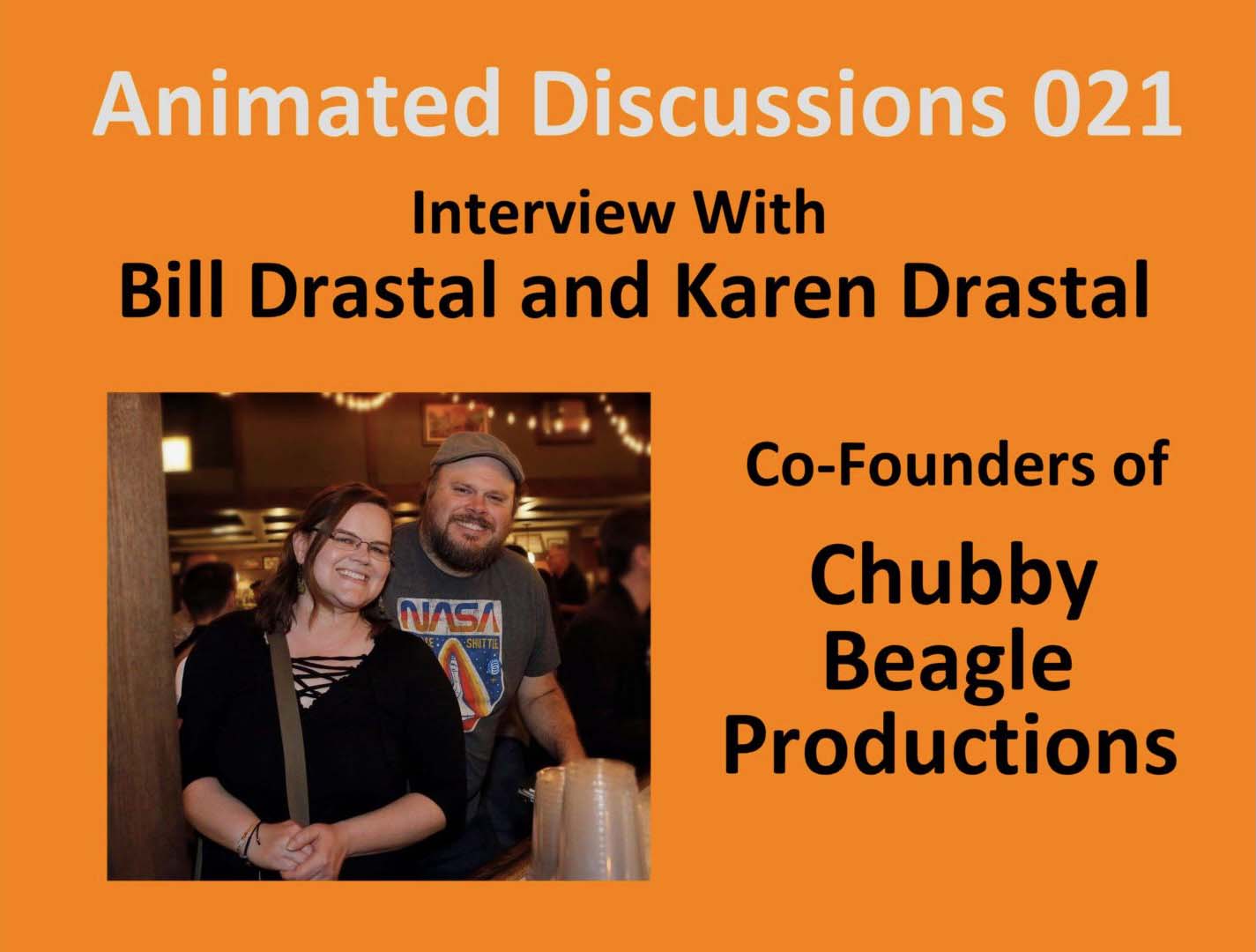
Bill & Karen Drastal

Animated Discussions 021 / Hosted by Davey Jarrell with Bill & Karen Drastal
Download this article
 Bill and Karen Drastal have been working in the TV animation industry since 2017. After working for many years as a caricaturist, Bill worked as a storyboard artist at Bento Box and Warner Brothers on shows like The Great North, Central Park, HouseBroken, and Yabba-Dabba Dinosuars!, where Karen also worked as a layout artist. They formed an independent animation studio in 2018 called Chubby Beagle Productions to provide an alternative to big studio animation. Through Chubby Beagle, Bill and Karen directed the storyboards and animation for the animated feature, Maxxie LaWow: Drag Super-shero, which has been making headlines in the festival circuit over the past year. Listen to Bill and Karen talk about what it’s like to run a small animation studio in the latest of Animated Discussions!
JOIN TODAY To Access Members Only Content
Whew! That is an amazing collection of treasures! The most important information isn’t what you already know… It’s the information you should know about, but don’t know yet. We bring that to you every other month.
THIS IS JUST THE TIP OF THE ICEBERG!
Animation Resources has been sharing treasures from the Animation Archive with its members for over a decade. Every month, our members get access to a downloadable Reference Pack, full of information, inspiration and animation. The RefPacks consist of e-books jam packed with high resolution scans of great art, still framable animated films from around the world, documentaries, podcasts, seminars and MORE! The best part is that all of this material has been selected and curated by our Board of professionals to aid you in your self study. Our goal is to help you be a greater artist. Why wouldn’t you want to be a member of a group like that?
Membership comes in two levels. General Members get access to a bi-monthly Reference Pack as well as a Bonus RefPack from past offerings in the in-between months. We offer a discounted Student Membership for full time students and educators.
JOIN TODAY!
https://animationresources.org/membership/levels/
FREE SAMPLES!
Not Convinced Yet? Check out this SAMPLE REFERENCE PACK! It will give you a taste of what Animation Resources members get to download every other month! That’s 560 pages of great high resolution images and nearly an hour of rare animation available to everyone to download for FREE! https://animationresources.org/join-us-sample-reference-pack/
 Animation Resources depends on your contributions to support its projects. Even if you can’t afford to join our group right now, please click the button below to donate whatever you can afford using PayPal.







 by
by