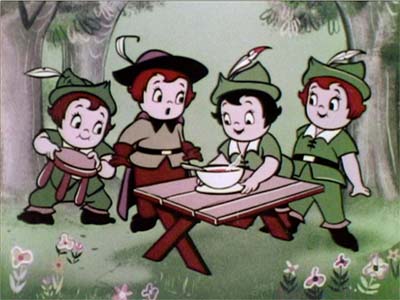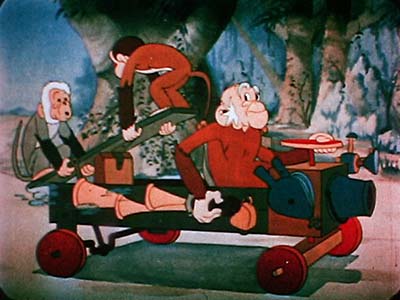
Every month, Animation Resources shares an amazing Reference Pack with its members. These carefully curated collections consist of e-books packed with high resolution scans video downloads of rare animated films set up for still frame study, as well as podcasts and documentaries— all designed to help you become a better artist. Members will have 30 days to download the current batch of treasures from the Animation Archive A new RefPack will be posted at the beginning of the next month. Bookmark the
Members Only Page and remember to check back every month, because when the new month starts, the old downloads go POOF!
MEMBERS LOGIN To Download
JOIN TODAY To Access Members Only Content
REFPACK071: May 2026
PDF E-BOOK:

Albrecht Durer Volume One

Early Woodblock Prints (1488-1498)
Download this article
I know what you’re thinking… What does a 15th century fine artist have to do with cartooning? Well, read on, because I think you’re going to be surprised!
A BRIEF BIOGRAPHY
Albrecht Dürer was born in Nuremberg, Germany in 1471. He initially intended to be a goldsmith, but his Godfather was a printer and in 1486 he secured Dürer an apprenticeship in the Wolgemut workshop producing woodblock prints. The fundamentals of art in Germany were more primitive than they were in other parts of Europe. Perspective and anatomy were rudimentary, and compositions tended to be flat. But it was the hub of printing technology at the time, and Dürer quickly picked up the trade.
After completing his apprenticeship around 1490, Dürer had a desire to better himself creatively; so he decided to visit and learn from other artists and goldsmiths, traveling throughout Northern Europe. During this period, new ideas in Dutch art were germinating as it transitioned from late Gothic to the early Renaissance. Dürer eagerly picked up inspiration and knowledge as he travelled. In 1494, he returned to Nuremberg and married, which was a requirement for opening one’s own workshop. But his marriage was ill-fated from the start, and within a few months he decided to leave Germany and travel to Venice, which was one of the artistic Meccas at that time. In Venice, he studied the work of Bellini, Raphael and da Vinci. He returned to Nuremberg the following year loaded with new ideas and opened his own workshop to produce inexpensive art prints known as “broadsheets”.

An example from Durer’s apprenticeship
DÜRER’S GROWTH AS AN ARTIST
This capsule biography of Dürer’s early years only tells a small part of the story. Something happened during Dürer’s trips abroad that altered his artistic output radically. Compare the images in the first section of this e-book to the ones in the second section. Dürer pushes the technology of woodblock printing far beyond what had been done before. The lines are more precisely carved, and he learns to spot the blacks and balance thickness of the lines to create more depth and maintain focus.
One print in particular marks a transition from simpler images to more complex ones: illustration number 87. In this print, Dürer decided to experiment with textured wood grain and drapery. The lines are finer than before and clustered together. But this came at a cost. The vintage book we digitized for this e-book was made from the best available copies of these prints in existence in the early decades of the 20th century; but this print was in significantly worse condition than the rest. Lines had become mashed up together. Sections of hatching were missing and the edges of the lines had become tattered and frayed. Restoration of this one print took nearly 300 hours of careful clean-up.

This print was an experiment in increasing the complexity of woodblock printing technique.
Part of the damage can be attributed to the larger print runs required to fill the growing demand for Dürer’s work; but it can also be explained by his inexperience with carving the block in a way that would protect more delicate lines. With the next print in the series, Dürer worked larger and avoided large areas of fine detail. He spread the contact surface of the block evenly across the whole image and made the lines less rigidly geometric. He also incorporated more organic textures to hide minor damage when it would occur.
The difference between the woodcuts Dürer produced in the next section is even more striking. Compare the images 88 to 93 with the ones from 98 to 102. Dürer’s artistic expertise increased to match his mastery of the technical aspects of woodblock printing. The images were more detailed with more precise carving of the lines. But that wasn’t all. Dürer applied the principles of perspective, anatomy and proportion he had learned from the Venetian painters to German craftsmanship, raising the prevalent Gothic style up to the standards of the High Renaissance.
Just when you might think that Dürer had reached his full potential, his artistry increased exponentially again with the Apocalypse prints (images 105 to 120). These prints represent the absolute pinnacle of woodblock printing. They excel in every metric: composition, flow, anatomy, perspective, style, and the visual expression of symbolic content. They were revolutionary at the time and they were the equal of anything created in Venice. They stand as one of the greatest achievements of the printer’s art.

Durer learned a great deal from his tour of Northern Europe.
DÜRER’S IMPORTANCE
The space of time covered by the contents of this e-book spans a little over a decade, from Dürer in his twenties to Dürer in his thirties. It’s hard to believe a person could progress that far in such a relatively short period. How did he do this? How can we follow his lead?
Dürer had a passion for self-study. He could have stayed in Nuremberg and built a successful business as a printer there, but that wasn’t enough for him. He travelled the length and breadth of Europe seeking out the greatest artists of his day to study under them. He wasn’t just an artist… he wrote books on mathematics, geometry, human proportion, the use of various kinds of weapons, as well as the architectural aspects of the fortification of castles. He was a true Renaissance man, but because he didn’t come from the artistic capitals in Italy and the Scandinavian countries, he has tended to be devalued by art historians.
When you read the history of cartooning, Dürer is even less mentioned, but he is probably the artist most responsible for establishing the principles that all cartoonists follow. It’s important to know that
the word “cartoon” originally meant “a study on paper of a design that would ultimately be rendered in paint.” Drawings were plans, not artistic objects that stood on their own. Before Dürer, the average person, if they saw art at all, only saw paintings and sculpture. It wasn’t until the introduction of woodblock printing around 1400 that the technology was used to render images in line, and it wasn’t until Dürer’s revolutionary prints that drawings were seen by the general public. Dürer established the basic techniques of expressing a volumetric form in flat lines, use of thicks and thins, hierarchy of line weight, spotting blacks, hatching, stippling, organic shapes… Today, we take these aspects of drawing for granted and assume that they always existed, but a great deal of what makes drawings great was established first by Dürer.

After his studies in Italy, Durer’s artistry grew tremendously.
The average person in the mid to late 15th century couldn’t read. Religious ceremonies and books were spoken and printed in Latin, which only the most educated monks and scholars could under- stand. But Dürer was able to interpret the Bible visually… which transcended language and education, bringing the stories vividly to life. The prints were inexpensive to produce in quantity and were sold to religious pilgrims as souvenirs of their trip to a holy place. They brought the piece of paper home with them and hung it on their wall to remind them of their faith. It became their primary daily contact point with their God.
But it was even more than that. Dürer understood his audience. In addition to the crucifixion prints designed to make the message of the Bible real to people, he selected stories that would appeal to the imagination of the common man… deaths of martyrs, Shadrach, Meshack and Abednego in the fiery furnace, Sampson killing the lion, Icarus flying too close to the sun, the Four Horsemen of the Apocalypse, and the Beast of Babylon. These fantastic images showed people things that they had never seen before- heroic deeds and otherworldly monsters.
The fame of Dürer’s prints spread far and wide. In fact, they were so popular that imitators made copies of them for sale, impacting Dürer’s own income. To fight back, he created a “trade mark”, the “AD” at the bottom of the prints to identify them as be- ing his work. However, the imitators just copied his trademark along with the rest of the print. These bootlegs incensed Dürer to the point that in 1506, he petitioned the court in Venice to prosecute Marcantonio Raimondi, an artist who was producing forgeries of Dürer’s most popular prints. This case established the concept of copyright, which is the legal mechanism used to protect artists’ works to this day.

Only eight years of study separated this image from the next one.
In our e-book dealing with Hans Holbein’s Dances of Death we traced the connections between early woodblock prints and modern cartooning. We identified the main connections as:
Line Drawing: The essence of a cartoon is the stylistic refinement of an image into a simplified rendering in line.
Caricature: Cartoons employ exaggeration, which illuminates truth and crystalizes a specific point of view.
Subject Matter: Usually, the subject matter of cartoons involves humor, political or social satire, adventure or fantasy.
Economics: Cartoons are usually mass-produced using an inexpensive, ephemeral medium aimed at an audience of common people.
While Dürer’s work doesn’t employ political satire and exaggeration the way Holbein’s prints do, it is ground zero for the other aspects. I recommend that you download our Best of 1 to 25 e-book during our next Members Appreciation Month to read the article there on Holbein’s Dances of Death. It elaborates further on the deepest roots of cartooning.
There are many things that can be learned from Albrecht Dürer, but perhaps the most important thing is the importance of self-study. In ten short years, he raised woodblock printing from a primitive craft to an art form. He also raised himself up as an artist. He did this by embracing new technology, exposing himself to the whole creative world at the time, and remaining inquisitive… In fact, he continued to learn and experiment and grow as an artist far beyond the period covered in this e-book. That’s something to emulate in our own careers. This e- book just barely scratches the surface of the amazing career of Albrecht Dürer. You should definitely do some Googling and learn more.

The images on our website are much lower resolution than in the e-book. Click on this image to get an idea of the level of detail in Animation Resources’ restoration of these important works.
ABOUT THIS E-BOOK
 Animation Resources was fortunate enough to obtain an original copy of Wili Kurth’s The Complete Woodcuts Of Albrecht Dürer (1927). Produced as a limited edition of around 1,000 copies, this legendary book assembled a complete run of high quality steel engravings made from the best available copies of the prints at the time. Reproduced in full size, the book is huge and heavy. Digitizing it has been a big job. Even more difficult is the time consuming task of digitally restoring the images. Most copies of these prints are reproduced from reprints of this book, like the Dover edition. The images were copied photographically and then printed inexpensively at a much smaller size by means of offset lithography. Because of this, lines became fuzzy around the edges, and fine areas of hatching blurred together into blobs of gray. Low resolution scans online further smear the line-work, resulting in poor approximations of the images that really don’t represent Dürer’s genius.
Animation Resources took a different approach. We scanned each page of the book at 1200 dots per inch, eliminated the yellowing and texture of the paper, and carefully replaced lines missing due to deterioration of the broadsheets or blocks using a digital tablet and stylus. It has taken us close to two and a half years to produce this e-book. We’re pleased with the result and hope you find it useful in your work.
This book was digitized by Toni Vang and digitally restored by Stephen Worth.
MEMBERS LOGIN To Download
JOIN TODAY To Access Members Only Content
DVD QUALITY VIDEO:
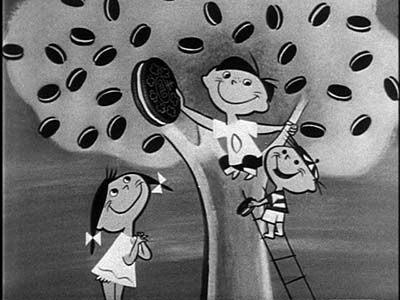
Assorted Commercial Reel
Paul Fennell Studios (ca. 1950s)
We continue our series of commercial reels from the Paul Fennell Studios with some spots that look forward to what Hanna-Barbera would be doing a few years later. The principle designer at Fennell was Ed Benedict, who went on to design Yogi Bear, Huckleberry Hound and many other classic characters for Hanna-Barbera.
Here Paul Fennell’s crew is joined by Hanna-Barbera’s first on-staff animator, Carlo Vinci. Unhappy with the direction the Terry-Toons studio had taken, Vinci had recently relocated his entire family from New York to the West coast to join his old friend Joe Barbera at MGM. But soon after he arrived, the MGM cartoon studio closed its doors, and Vinci was out of work. He was quickly hired by Disney to animate for the wrap around segments in the Disneyland TV series, but Vinci wasn’t happy with the “old boy” attitudes and the slow pace of the work at Disney. He took freelance work for Fennell on commercials and was introduced to Ed Benedict whose design sense lent itself perfectly to Vinci’s animation style. When Hanna-Barbera was formed in 1957, Vinci and Benedict were among the handful of artists who were the first to be hired, and they helped to establish the studio’s house style.
Ed Benedict likely designed and laid out all of these commercials, and Vinci’s animation can be seen sprinkled throughout this reel. The Ipana Toothpaste and the Swiss Creme Sandwich cookie spots appear to be entirely animated by Vinci. This reel of animated commercials produced by the Paul Fennell Studios includes spots that haven’t been seen in over half a century. We thank the family of Paul Fennell for sharing them with us.
MEMBERS LOGIN To Download
JOIN TODAY To Access Members Only Content
DVD QUALITY VIDEO:
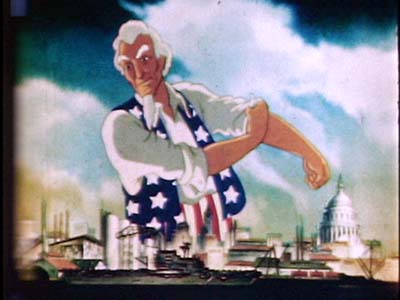
Broken Treaties / This Changing World
Paul Fennel Studios (1941)
When Ub Iwerks decided to end his contract with Columbia Pictures and leave his own studio behind, Paul Fennell stepped up to take over the reins of Cartoon Films Ltd. One of the first projects that was announced early in 1941 was a current events series outlining the recent military actions taken by the Nazis in Europe. This was before Pearl Harbor and many Americans took an isolationist attitude.
Animator Tom Minton, who worked with Fennell at Filmation in the late 70s remembers him screening these cartoons for the crew. Fennell told them that when “Broken Treaties” opened in Westwood in August of 1941, the audience broke into a chorus of boos, reacting to the blatant propagandizing and the caricatures of European leaders that they would have preferred to ignore. When the second film, “This Changing World” debuted in late December of 1941, the reaction was the exact opposite. The attack on Pearl Harbor was in the headlines, and it was clear that the United States was going to war. Audiences responded favorably, and “This Changing World” was nominated for an Academy Award.

It’s clear that Disney was influenced by these films in making “Victory Through Air Power”. They share a similar format, with a commentator at a desk narrating, animated maps and dramatic scenes of battle rendered in limited animation with lots of camera effects. Paul Fennell pioneered the use of animation for propaganda purposes that would be used later at all the major studios, as well as the First Motion Picture Unit.
Because of the ephemeral nature of these films, these two 16mm prints may be the last surviving copies of these films in existence. Animation Resources thanks the family of Paul Fennell for sharing these with us.
MEMBERS LOGIN To Download
JOIN TODAY To Access Members Only Content

The world of animation is much bigger than it might appear to us at first glance. We are all familiar with the films we grew up with, but Hollywood wasn’t the only place that produced great cartoons… Poland, Japan, Russia, China and Europe all have their own traditions and a rich history of animated film making. Animation Resources’ archive contains many foreign films that are rarely seen in the United States. We feature a sampling of interesting animation from around the world in each Reference Pack.
DVD QUALITY VIDEO:
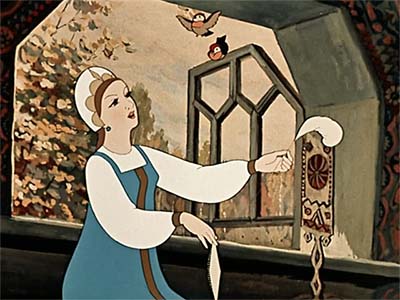
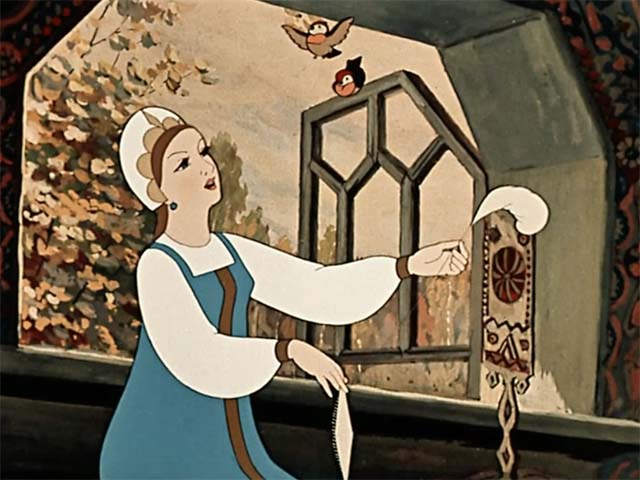
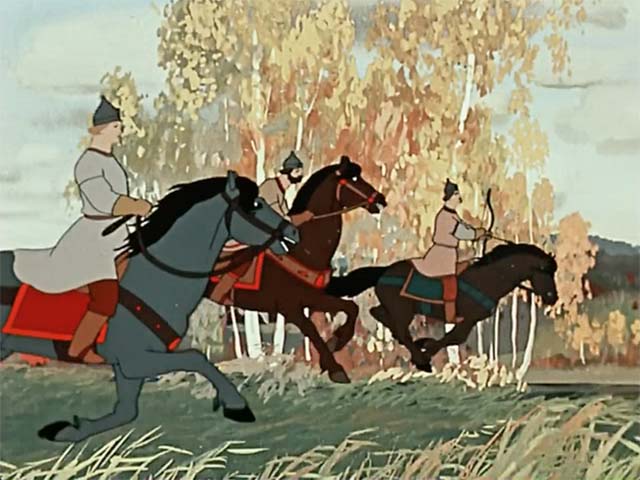
Dead Tsarevna & The Seven Bogatyrs

Ivan Ivanov-Vano / 1951
Download this article
Although this film closely resembles the story of “Snow White and the Seven Dwarfs”, this adaptation is based on a Russian fairy tale about the Princess Tsarevna. The film closely follows the poem written in 1833 by Aleksandr Pushkin. If you are interested, there is a synopsis of the story at Wikipedia.
The director of this film, Ivan Ivanov-Vano began his career in animation in 1927 and made three dozen films over his half century career, most of which were based on Russian folk tales. Early on, he was heavily influenced by Disney, but his personal style developed and grew over his career. In 1947 he directed the first Russian animated feature film, The Humpbacked Horse; and he helped establish ASIFA (The International Animated Film Society) in 1961.
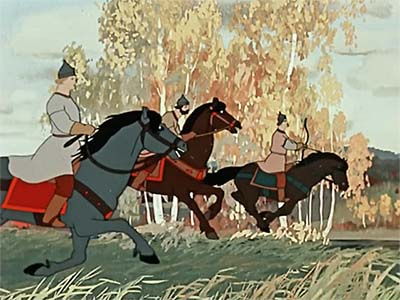
This film incorporates design motifs unique to Russian art and it reflects its culture perfectly. In the modern world, animated films are made in Asia, India, Europe and the United States that all look pretty much the same. It would be good if a diversity of regional styles developed again. After all, art should be a personal expression of one’s life and culture, not a product manufactured to someone else’s design.
MEMBERS LOGIN To Download
JOIN TODAY To Access Members Only Content
DVD QUALITY VIDEO:
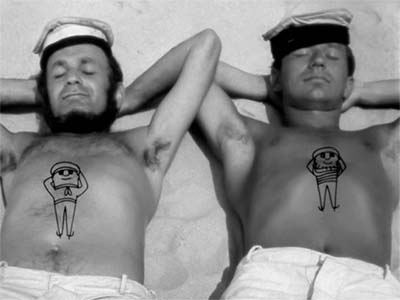
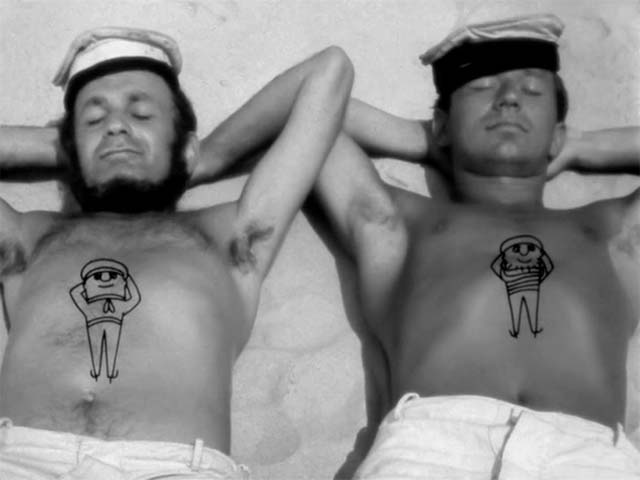
Plaza (Beach)
Edward Sturlis / Poland / 1964
Poland is known for the wide diversity of its animation, from children’s puppet animation to surrealistic nightmares to important social and political commentary to pioneering computer animation. In general, Polish films are less focused on narrative than they are in putting across feelings and states of mind. We will be sharing more of the great work of Polish animators in the near future, but today we have a more straightforward little treat for you… Edward Sturlis’s “Beach”. I’m not going to say too much about it and let you discover its charm for yourself. It’s proof that sometimes the simplest ideas and the simplest execution is the best.
MEMBERS LOGIN To Download
JOIN TODAY To Access Members Only Content
SD VIDEO:

Koziolik Matolik in “Dragon’s Cave”
Sophia Oraczewska / Studio Miniatur Filmowych, Poland / 1969
Studio Miniatur Filmowych in Krakow, Poland was established in 1958, and since then it has produced nearly 1,500 animated films. This series, titled The Strange Adventures of Koziolek Matolek was produced between 1969 and 1971 and 26 episodes were made. The current episode is titled "Dragon’s Cave". We will be sharing more of these in upcoming Reference Packs.

Koziolek Matolek was created in 1933 as a character in Polish comic books. The idea behind the character is a bit surreal, and might seem odd to us in America… Koziolek Matolek is a goat who undertakes a quest to find Pacanow, a town where he has heard that they make shoes for goats. His travels take him to the ends of the Earth and throughout time from the jungles of Africa to medieval Europe to the Wild West. Although the character’s adventures have been well known for generations in Poland and are a staple of children’s literature there, I don’t believe any of the stories, comics or cartoons have ever been translated and distributed outside of that country.

The cartoons were directed by a variety of animators, and the character looks a bit different in each of the individual director’s episodes. The focus is on funny movement and expressions, all while maintaining an admirable level of clarity and economy. This series is a model of what internet cartoons could be.
MEMBERS LOGIN To Download
JOIN TODAY To Access Members Only Content
Whew! That is an amazing collection of treasures! The most important information isn’t what you already know… It’s the information you should know about, but don’t know yet. We bring that to you every other month.
THIS IS JUST THE TIP OF THE ICEBERG!
Animation Resources has been sharing treasures from the Animation Archive with its members for over a decade. Every month, our members get access to a downloadable Reference Pack, full of information, inspiration and animation. The RefPacks consist of e-books jam packed with high resolution scans of great art, still framable animated films from around the world, documentaries, podcasts, seminars and MORE! The best part is that all of this material has been selected and curated by our Board of professionals to aid you in your self study. Our goal is to help you be a greater artist. Why wouldn’t you want to be a member of a group like that?
Membership comes in two levels. General Members get access to a bi-monthly Reference Pack as well as a Bonus RefPack from past offerings in the in-between months. We offer a discounted Student Membership for full time students and educators.
JOIN TODAY!
https://animationresources.org/membership/levels/
FREE SAMPLES!
Not Convinced Yet? Check out this SAMPLE REFERENCE PACK! It will give you a taste of what Animation Resources members get to download every other month! That’s 560 pages of great high resolution images and nearly an hour of rare animation available to everyone to download for FREE! https://animationresources.org/join-us-sample-reference-pack/
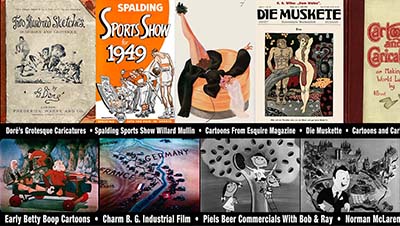
 Animation Resources depends on your contributions to support its projects. Even if you can’t afford to join our group right now, please click the button below to donate whatever you can afford using PayPal.


 by
by